
In this article
Before I tell you about Operent, answer three questions about your last month:
- How much did each property really leave you, after every expense?
- How much belongs to each owner, and why?
- How much was left for your company?
If all three answers take five minutes and you trust them, Operent isn't for you. Your operation runs smoothly. Don't change a thing.
If answering means opening the bank statement, the card bill, WhatsApp to chase receipts and the spreadsheet you rebuild every month, keep reading.
I got to the number. Getting there cost a lot.
I manage my own listings and I co-host a property for an owner. I knew how much each property left me. But knowing it came at a price.
Every booking for every property went into a separate spreadsheet, one per owner. Then I entered the expenses and checked everything. At the end, I built the owner's report by hand. The next month, all over again, from scratch.
It took a whole afternoon to pull the numbers together. And with so much typed by hand, there was always room for error. Comparing one month with another, or with the previous year, was even worse: slow and unreliable.
The number existed. What was missing was a place where it built itself. Operent is that place.
It's not a lack of organisation. It's a lack of place.
People in short-term rentals tend to be organised. The problem is that each tool shows one piece:
- Airbnb and your PMS show bookings and occupancy.
- The bank shows what came in and went out of the account.
- The spreadsheet tries to bring it all together, by hand, every month.
The same booking ends up typed three times, and one missing booking is enough for the month not to close.
And the money doesn't always go through your account. With Airbnb co-host payouts, the owner's share lands straight in their account, and the expenses they pay never reach you. With centralized payments, the bank balance looks great, but much of it already belongs to someone else: the owner's payout.
Either way, the number you see isn't the number that matters.
What Operent is
Operent is the financial layer for companies that manage short-term rentals on behalf of owners.
Each booking is recorded once and carries its property, channel, owner and payout rule. From that single base come three views of the same operation:
- Your company: what came in from management fees and your own properties, what went out in expenses, and the margin that's left.
- Each property: its result month by month, with every expense, including the ones the owner paid directly.
- Each owner: every booking, the management fee, every expense and how the payout was made.
At month-end, the payouts and each owner's statement are ready. No spreadsheet to rebuild.
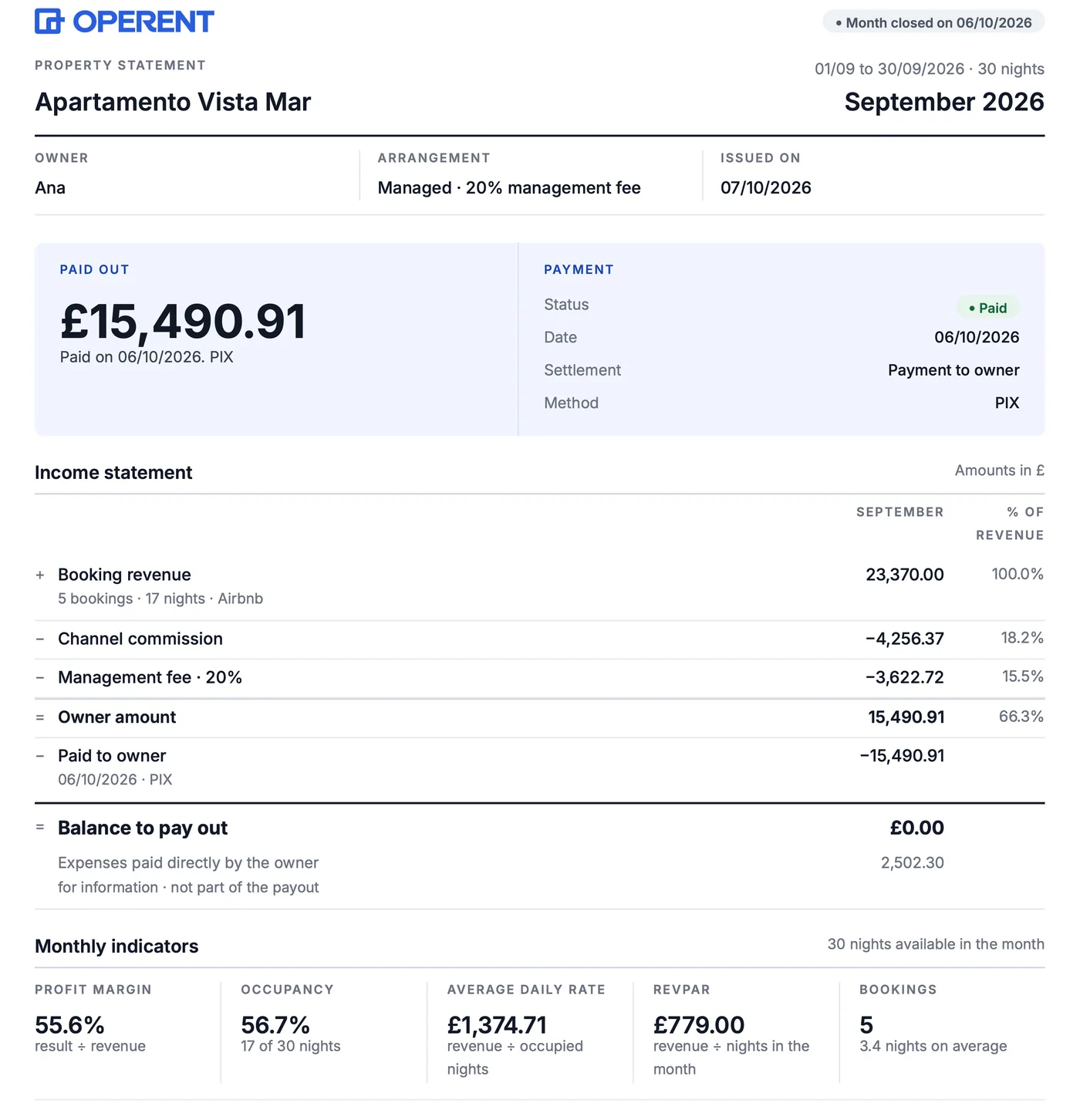
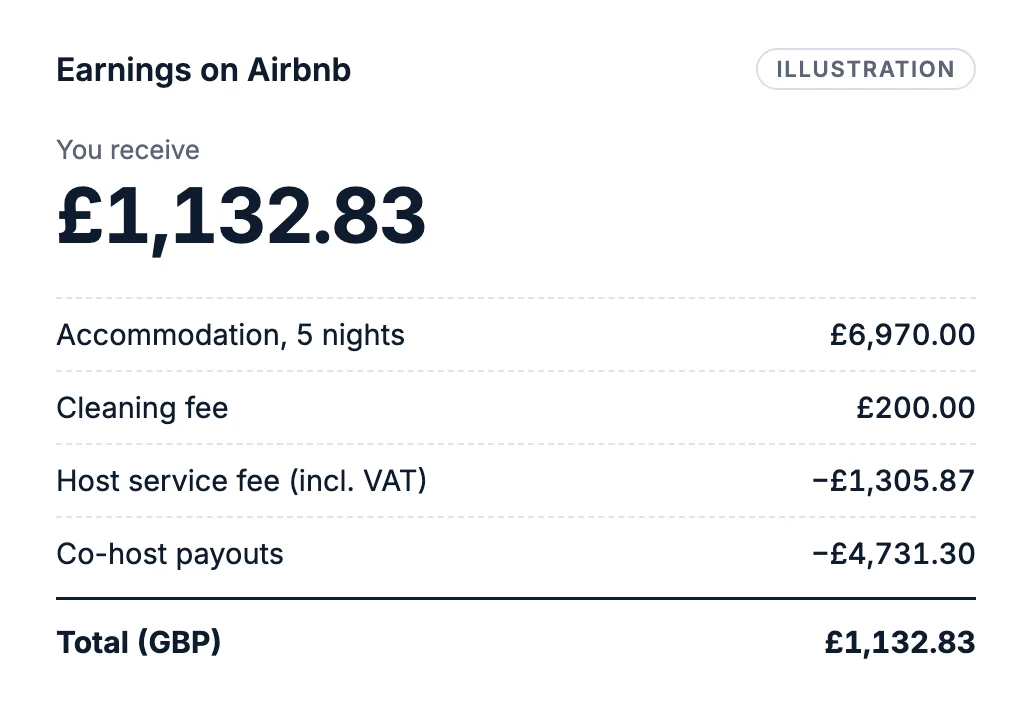
And the number matches Airbnb's. The first booking in this statement uses the values of a real Airbnb booking, shown here in pounds: side by side, Airbnb and Operent land on the same penny, £1,132.83 for the manager and £4,731.30 for the owner.
The question that changes month-end: who paid?
In that same booking, the owner received £4,731.30. That month, they also paid for the cleaning and had the water heater repaired. Nobody wrote it down. They think the property made £4,731.30. It made £4,231.30. The full maths is in this article.
That's why, in Operent, every expense starts with one question: who paid? If your company paid, it's a company cost or a deduction from the payout. If the owner paid, it goes into the property's result without touching your cash. It works with co-host payouts and with centralized payments, and every expense has room for the receipt.
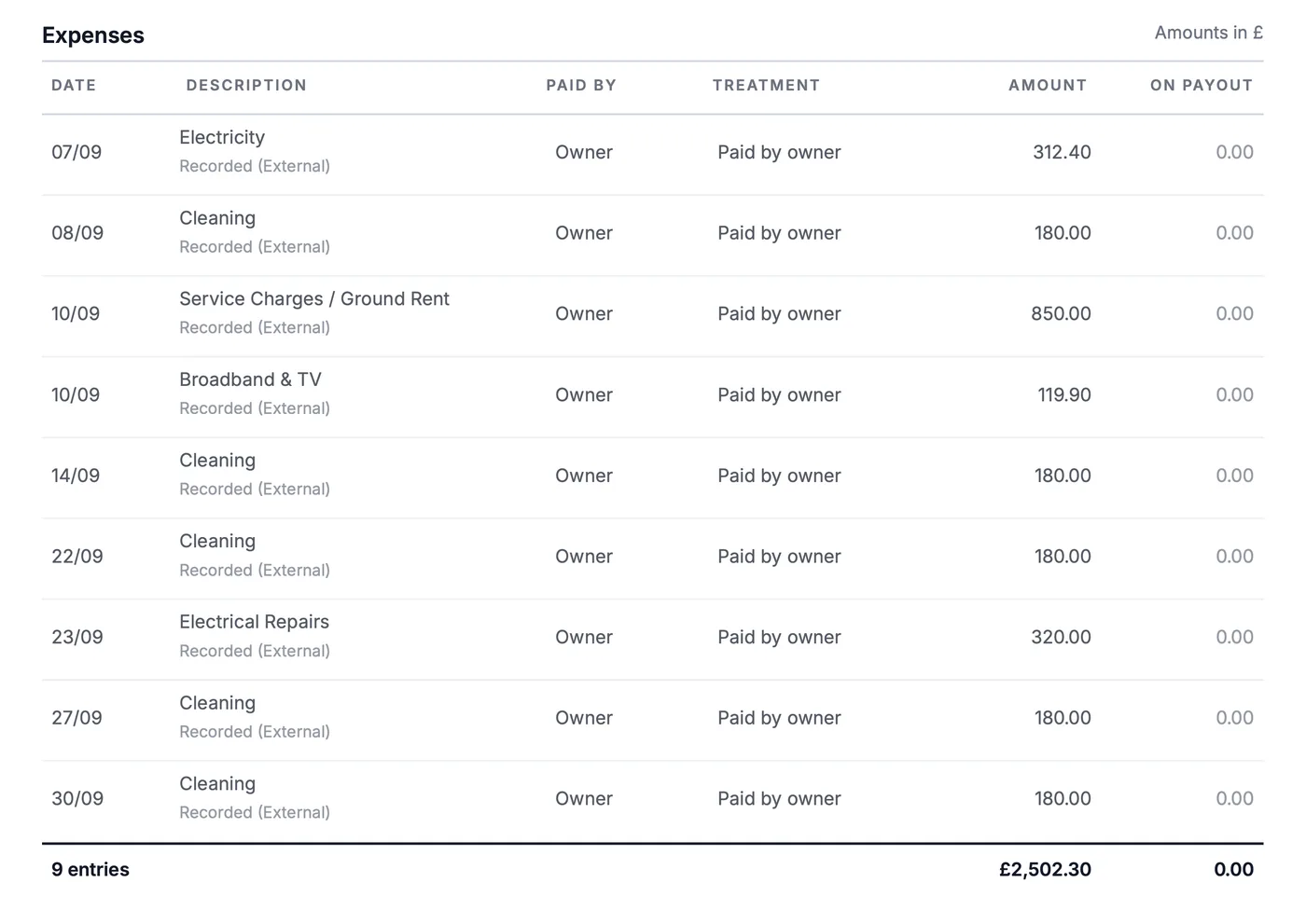
Recording the expense that never went through your account takes work. It's also what gives the owner the real margin on their property, and what makes them trust your number instead of checking it.
What the first users say
Luis Eduardo, founder of UraHost in Minas Gerais, Brazil, ran his management on spreadsheets, like I did:
“I could track how much profit each property was making and get an overview of the month, but I was missing a very important piece of information: truly understanding the margin of each property.”
And after Operent:
“I can quickly identify the properties that aren't performing well and assess whether it's worth keeping them under management.”
Bruno Aprígio, a host in Serra, Espírito Santo, started from somewhere else:
“I knew how much I was receiving, but I had no clarity about the expenses and, above all, about how much was really left at the end.”
One already had the spreadsheet. The other had no control at all. Both got to the same place: knowing the margin of each property and deciding based on it. Testimonials translated from Portuguese.
What your spreadsheet costs
Mine was a whole afternoon every month. Do the maths with yours.
Think about your last month-end and add up the hours: checking bookings and payments, entering expenses, chasing receipts, calculating payouts, building each owner's statement. Multiply by 12.
That's the yearly price of the spreadsheet. And it still doesn't include the mistake nobody sees: the forgotten expense, the payout calculated wrong, the property that looks profitable and isn't.
Numbers are for deciding
Short-term rental management is a business, and a business is run on numbers.
A property that closed April in the red because of a renovation doesn't show up in the monthly total. It shows up when you look at that property, month by month. And not every drop in revenue is the same: only the comparison with the same period last year tells you whether it was seasonality or a problem.
With the number in hand, you know which property is carrying the others, you have a case for renegotiating your management fee, and you can show an owner, with data, that their property needs investment.
And your portfolio grows. With two properties, you can keep it all in your head. With twenty, you can't. Whoever organises their finances before growing grows in control. Whoever leaves it for later finds the problem at the worst moment, with more owners asking at the same time.
And operations, in the same place
Growing also means not letting the operation depend on your memory. That's why Operent runs the day-to-day alongside the finances:
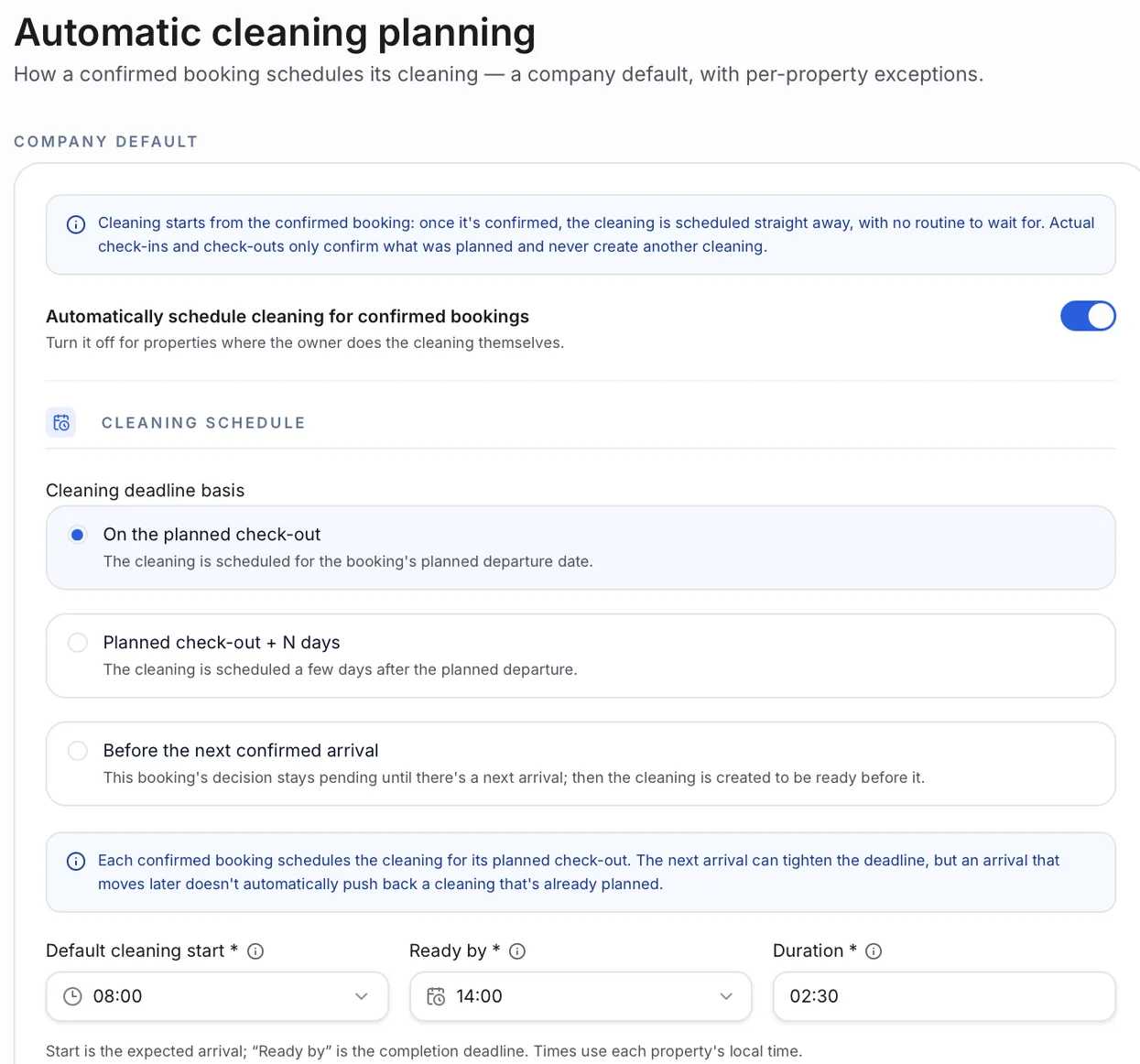
- Cleaning schedules itself. When a booking is confirmed, the cleaning is created the way you choose: on the check-out day, a few days after it, or only once the next booking comes in, so it's ready before the next guest. It comes with a time, a deadline, a service provider and that property's instructions. There's a company default with per-property exceptions, and you can turn it off where the owner handles the cleaning.
- What repeats becomes a routine. Cleaning the air conditioning every two weeks, maintenance every week: you set it up once and the tasks are created as far ahead as you decide.
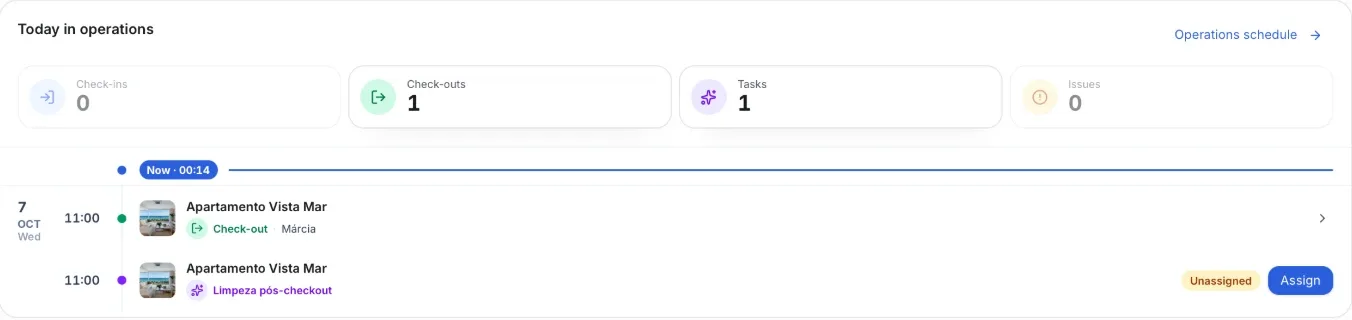
- The day starts with what needs action. Check-ins, check-outs, overdue tasks and unassigned tasks come first, before they turn into a problem with a guest.
What Operent isn't
- It doesn't replace your PMS or channel manager. It works alongside them. What it replaces is the financial spreadsheet.
- It doesn't make you type everything again. If you want to bring your history, it comes in by spreadsheet. If not, you start from the month you join Operent. New Airbnb bookings arrive from the confirmation emails.
- It doesn't leave you to set it up alone. During early access, we set it up with you.
Back to the three questions
How much each property left. How much belongs to each owner. How much was left for your company.
If you can answer all three with confidence, carry on as you are. If not, your next month-end could be your first on Operent.
- Free early access. No card, during validation.
- 26 founding operator seats. The first 26 approved companies that activate their access get 50% off list price for as long as the subscription remains active.
- I read your request myself. I reply within 5 working days.
I want to close next month on Operent
Fabiano Gobbi, founder of Operent
In this articleearly access
See this flow with your own properties.
Operent is in early access and free during the validation phase. We stay close through your setup and your first month-end close.